Home / Buyer Guides / Custom Gloves Manufacturing Guide
Custom Gloves Manufacturing Guide: Work, Welding, Motocross and Dress Gloves
How to specify custom gloves that perform: leather types, cut patterns, cuffs, linings, safety standards and what to check before you place a bulk order with a glove manufacturer.
Updated November 2026 · Villgro Wears production team, Sialkot
On this page
Key points
- Start with the job the glove must do: grip, heat, abrasion, impact or style.
- Cowhide is the most durable, goatskin the most dexterous, sheepskin the softest.
- Cut pattern, thumb design and cuff style change fit and protection as much as the leather.
- If you sell safety gloves, ask for test reports to the standards your market requires.
Start with how the glove will be used
A glove that is perfect for a welder will feel clumsy to a mechanic, and a soft dress glove will not survive a construction site. Before you choose materials, write down where and how the glove will be worn:
- Main risk: abrasion, cuts, heat and sparks, impact, cold or simply style.
- Dexterity needed: fine work such as assembly, or heavy handling.
- Conditions: wet, oily, hot or cold environments.
- Buyer: safety distributors, motorsport brands, cycling shops or fashion retailers each expect different finishes and packaging.
With this brief, a custom gloves manufacturer can recommend the right leather, construction and price point instead of guessing.
Choosing the right leather
| Leather | Character | Typical gloves |
|---|---|---|
| Cowhide (grain) | Durable, abrasion-resistant, good value | Work and driver gloves, motorcycle gloves |
| Cowhide (split) | Thicker, rougher, heat-resistant | Welding gauntlets, heavy-duty work gloves |
| Goatskin | Thin, strong, flexible, natural lanolin | Mechanic, assembly and precision work gloves |
| Sheepskin / lambskin | Very soft, fine grain, elegant | Dress and fashion gloves |
| Pigskin | Breathable, stays supple after getting wet | Utility and outdoor gloves |
| Synthetic leather | Consistent, washable, cost-effective | Motocross, cycling and mechanic gloves |
Grain leather is the outer surface of the hide: smooth, tighter and more resistant to moisture. Split leather comes from the inner layers: thicker and rougher, with excellent heat resistance but less dexterity. Many work gloves combine both, for example a grain palm with a split or fabric back.
Cut pattern, thumb and cuff
Construction decides how a glove fits and where it wears out. Three choices matter most:
Cut pattern
Gunn cut has no seams on the palm side of the fingers, which improves comfort for gripping tools. Clute cut uses a one-piece palm with seams on the back, a durable and economical choice for general work.
Thumb design
A keystone thumb is set into the palm and gives the best flexibility. A wing thumb is cut from the same piece as the palm, removing a seam from the high-wear area. A straight thumb is simple and suits heavy handling.
Cuff style
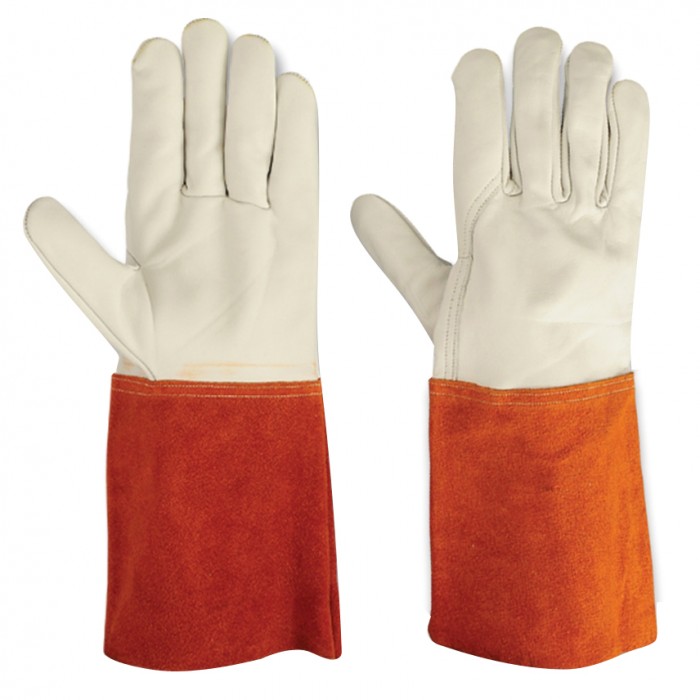
Knit wrists keep debris out, safety cuffs allow quick removal, elastic or hook-and-loop closures give a secure fit, and long gauntlet cuffs protect the forearm in welding.
Work and welding gloves
Work gloves are judged on durability, grip and protection. Common options include reinforced palm patches, knuckle protection, impact-resistant TPR on the back of the hand, and cut-resistant liners for metal handling.
Welding gloves need heat resistance above everything else. They are usually made of split cowhide or goatskin with a long gauntlet cuff, an insulating lining and heat-resistant thread, because standard thread can burn through and open the seams. TIG welders often prefer thinner goatskin for control; MIG and stick welders need heavier split leather. See our work gloves range.
Motocross, cycling and dress gloves
Motocross and motorcycle gloves
Riders want feel on the controls first. Motocross gloves typically use a thin synthetic palm, stretch back panels and light knuckle protection. Road riding gloves add leather, hard knuckle shells and palm sliders. See our motocross gloves.
Cycling gloves
Fingerless or full-finger designs with gel or foam palm pads, breathable mesh backs, and a terry thumb panel. Pull tabs make them easy to remove. See our cycling gloves.
Dress gloves
Fashion and driving gloves depend on fine leather, precise stitching and the right lining: silk or polyester for a slim fit, wool or cashmere blends for warmth. See our dress gloves.
Safety standards for selling gloves
If you market gloves as protective equipment, buyers and regulators will expect test results. The most common references are:
| Standard | What it covers | Where it matters |
|---|---|---|
| EN 388 | Mechanical risks: abrasion, cut, tear and puncture | Europe, UK and many global buyers |
| EN 407 | Heat and flame | Heat-resistant and welding gloves |
| EN 12477 | Protective gloves for welders (Type A and B) | Welding gloves in Europe |
| ANSI/ISEA 105 | Cut, puncture and abrasion levels | USA and Canada |
| EN 13594 | Motorcycle gloves, including knuckle protection | Motorcycle gloves sold in Europe |
Testing is done by accredited laboratories on your final design and materials. Agree early which standards your products need, because the result depends on the leather, lining and construction you choose. Ask your manufacturer for current test reports, and for Europe check whether your products need CE marking as personal protective equipment.
Branding and packaging
Gloves offer several branding areas: a printed or embossed logo on the back of the hand, a silicone or rubber patch, a branded hook-and-loop tab or a woven label inside the cuff. For retail, consider header cards, hang tags, barcodes and polybags with size stickers. Confirm the exact logo size and position on the sample. More options are on our branding page.
Sizing, samples and quality checks
Glove sizing varies by brand and region, so send your size chart or a reference glove for each size. Sizes are usually based on hand circumference and length.
- Check fit and finger length on several people across your size range.
- Flex the glove and look at the stitching at the fingertips and thumb.
- Check leather thickness and consistency between left and right gloves.
- Confirm colors, logo placement and label details.
- For welding gloves, confirm the lining and heat-resistant thread.
At Villgro Wears, the MOQ is 50 pairs per style and color, and samples take 7–10 days. Sialkot is one of the world’s best-known glove-making centers, with skilled cutters and stitchers who specialize in leather. For general supplier checks, read our guide on choosing a manufacturer.
Questions about custom gloves
What is the MOQ for custom gloves?
Villgro Wears produces custom gloves from 50 pairs per style and color, which is suitable for testing a new line or ordering for a team or a company.
Which leather is best for work gloves?
Cowhide is the most durable general-purpose choice. Goatskin gives better dexterity for precise work, and split cowhide is preferred for heat and welding.
Can you make gloves to my own design?
Yes. Send a tech pack, a sample glove or photos with your materials and branding requirements, and we will develop a sample for approval.
Are your gloves certified to EN 388 or ANSI standards?
Certification depends on the final design and materials. Tell us which standards your market requires, and we will discuss the materials and testing route for your products.
How long does glove production take?
Samples take 7–10 days. Bulk production normally takes about 3–4 weeks after sample approval, depending on quantity and complexity.
Plan your glove line
Tell us the type of glove, the materials you prefer and your quantities. We will recommend the right construction and send a quotation.